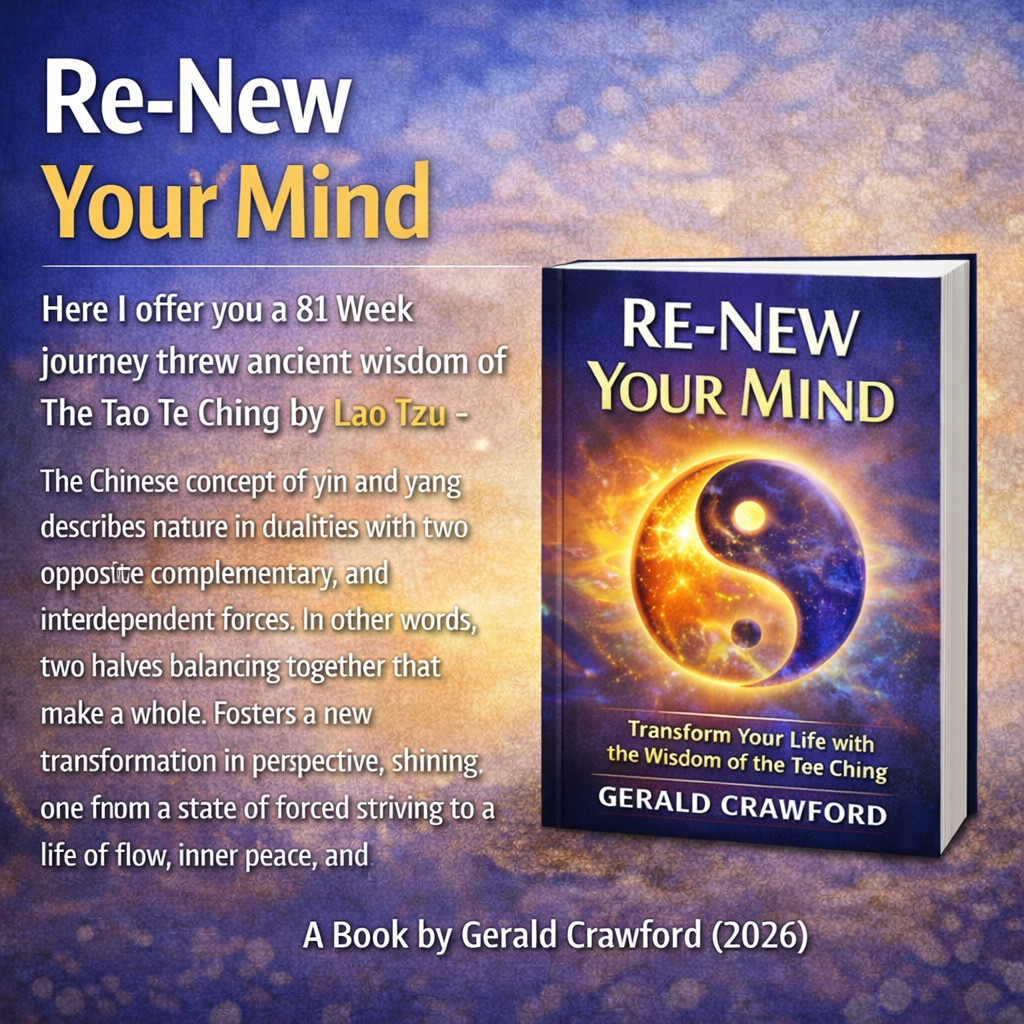
Here I offer you a 81 Week journey threw ancient wisdom of The Tao Te Ching by Lao Tzu - The Chinese concept of yin and yang describes nature in dualities with two opposite, complementary, and interdependent forces. In other words, two halves balancing together that make a whole. Fosters a new transformation in perspective, shifting one from a state of forced striving to a life of flow, inner peace, and harmonious action.

Author: Gerald Crawford (Page 2 of 5)

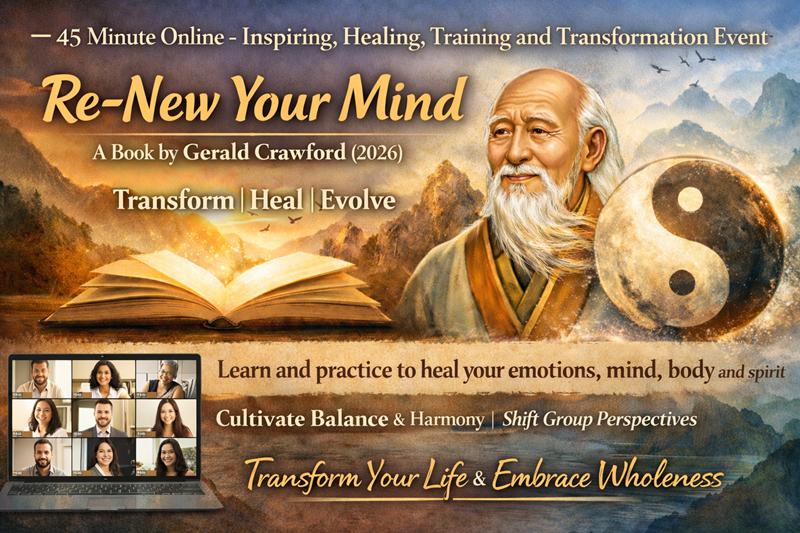
45 Minute Online – Inspiring, Healing, Training and Transformation Event – Learn about and practice Re-New Your Mind to transform your life, heal your emotions, mind, body and spirit. With a practical Case Study, EFT Tapping Session inside a Therapy and Healing Model.

45-Minute Online Event

Re-New Your Mind – Inspiring, Healing, Training & Transformation Experience

Event Title:
Re-New Your Mind – Transform Your Mind, Heal Your Life

Host: Gerald Crawford
Duration: 45 Minutes
Format: Live Online Training & Healing Experience


Event Overview

This 45-minute online event introduces participants to the transformative principles found in Re-New Your Mind, inspired by the ancient wisdom of the Tao Te Ching by Lao Tzu.

Participants will explore how renewing the mind can shift life from stress, emotional struggle, and forced striving toward balance, flow, healing, and inner peace.

The session combines inspiration, practical teaching, emotional healing techniques, and guided practice, helping participants experience the principles in action.

The event includes a real-life case study and a guided EFT (Emotional Freedom Technique) tapping session integrated into a structured healing therapy model.


Event Structure (45 Minutes)

1. Welcome & Opening (5 Minutes)

Introduction to the event and its purpose.

Topics covered:

  • Why many people feel emotionally overwhelmed today

  • The importance of renewing the mind

  • How perspective influences emotional and physical well-being

  • Introduction to the philosophy behind Re-New Your Mind

Participants are invited to begin the session with openness and curiosity.


2. The Wisdom of Balance (10 Minutes)

Introduction to the key teachings from the Tao Te Ching that inspire the book.

Key concepts:

  • The Tao – living in harmony with life’s natural flow

  • Yin and Yang – understanding balance in life

  • Moving from forcing outcomes to living with awareness and flow

Participants learn how imbalance in thinking often leads to emotional and physical stress.


3. Practical Case Study (10 Minutes)

A real-life case study demonstrates how the Re-New Your Mind framework can support emotional healing.

Topics explored:

  • Identifying emotional triggers

  • Understanding internal imbalance

  • Applying awareness and reflection to shift perspective

Participants see how ancient wisdom can be applied in modern therapeutic settings.


4. Guided EFT Tapping Healing Session (15 Minutes)

Participants are guided through a practical Emotional Freedom Technique (EFT) tapping session designed to release emotional tension.

The session focuses on:

  • Identifying a specific emotional stress or limiting belief

  • Using tapping points to regulate the nervous system

  • Reframing thoughts toward balance and inner calm

The tapping sequence helps participants experience how mind-body techniques can support emotional healing.


5. Integration & Closing Reflection (5 Minutes)

The final segment helps participants integrate the experience.

Topics covered:

  • How small perspective shifts create meaningful life change

  • The importance of gradual personal transformation

  • How the 81-week journey in Re-New Your Mind supports long-term growth

Participants leave the session with practical insights and tools they can continue using in their daily lives.


What Participants Will Experience

During this event participants will:

  • Learn how ancient wisdom can guide modern emotional healing

  • Understand how imbalance in thinking affects well-being

  • Experience a guided EFT tapping practice

  • Gain practical tools to reduce emotional stress

  • Discover how renewing the mind can transform perspective and life experience


Who This Event Is For

This experience is designed for individuals who want to:

  • Reduce stress and emotional overwhelm

  • Develop greater self-awareness

  • Learn practical mind-body healing techniques

  • Explore the wisdom of the Tao Te Ching in modern life

  • Begin a journey of personal transformation


Event Outcome

Participants will leave the event with:

  • Greater emotional awareness

  • A practical healing technique they can apply immediately

  • A deeper understanding of balance and flow

  • Inspiration to begin renewing their mind and perspective


Closing Message

Transformation begins when the mind begins to see differently.

By renewing the mind and restoring balance between thought, emotion, and action, individuals can move from striving and stress toward flow, clarity, healing, and inner harmony.


Re-New Your Mind
A journey toward balance, awareness, and transformation.
Case Study 206: Applying Re-New Your Mind A Book by Gerald Crawford (2026) Ancient wisdom of The Tao Te Ching by Lao Tzu Information in a Addiction Healing Therapy Model

Case Study 206

Applying Re-New Your Mind in an Addiction Healing Therapy Model

Inspired by the Wisdom of the Tao Te Ching

Book: Re-New Your Mind
Author: Gerald Crawford (2026)


Overview

This case study explores how the principles outlined in Re-New Your Mind, inspired by the wisdom of the Tao Te Ching, can support individuals recovering from behavioral addiction. The healing model emphasizes restoring inner balance, awareness, and self-regulation, rather than focusing solely on eliminating the addictive behavior.

Addiction often arises when individuals attempt to manage emotional discomfort through external coping mechanisms. Taoist philosophy encourages a return to natural balance, acceptance, and mindful awareness, helping individuals reconnect with themselves and develop healthier responses to stress and emotional triggers.


Client Background

Client Profile:
Female, age 32
Occupation: Administrative assistant

Presenting Challenges:

  • Compulsive social media and online usage

  • Difficulty focusing on daily responsibilities

  • Sleep disruption due to late-night phone use

  • Increased anxiety and comparison with others

The client reported spending excessive time on social media as a way to escape feelings of loneliness and dissatisfaction.


Presenting Problem

During the initial sessions, the client described:

  • Difficulty controlling the urge to check social media

  • Constant comparison with others’ lifestyles

  • Reduced productivity at work

  • Feelings of guilt and frustration after extended online use

The addictive pattern reflected a cycle of emotional discomfort, digital escape, temporary distraction, and emotional dissatisfaction.


Therapeutic Framework

The addiction healing model integrated reflections from Re-New Your Mind using five Taoist-inspired stages:

  1. Recognizing Habitual Patterns

  2. Understanding Emotional Triggers

  3. Restoring Balance Between Mind and Environment

  4. Cultivating Awareness and Self-Control

  5. Reconnecting with Meaningful Life Activities

The focus was on gradually renewing the client’s perspective and relationship with technology.


Stage 1: Recognizing Habitual Patterns

The client was encouraged to observe her daily habits without judgment.

Through reflective journaling, she identified key triggers for excessive phone use, including boredom, loneliness, and moments of stress.

Outcome:
The client became aware of how automatic the behavior had become.


Stage 2: Understanding Emotional Triggers

Using the Taoist principle of awareness, therapy sessions explored how emotional discomfort often triggered the urge to escape into digital distraction.

The client began recognizing how comparison and external validation were influencing her emotional state.

Outcome:
She developed a clearer understanding of how her emotions and online behavior were connected.


Stage 3: Restoring Balance

The concept of yin and yang was introduced to illustrate the importance of balancing stimulation with stillness.

The client explored how constant digital stimulation disrupted mental calm and personal focus.

Practical steps included:

  • Creating device-free periods during the day

  • Limiting social media usage

  • Introducing quiet reflection time before bed

Outcome:
The client reported improved sleep and reduced mental restlessness.


Stage 4: Cultivating Awareness and Self-Control

The therapy model introduced mindfulness-based practices to strengthen self-regulation:

  • Pausing before reaching for the phone

  • Practicing mindful breathing when urges arose

  • Observing emotional states without reacting immediately

Outcome:
The client experienced fewer impulsive phone-checking behaviors.


Stage 5: Reconnecting with Life Balance

In the final stage, the client focused on activities that created a healthier sense of fulfillment.

These included:

  • Spending more time outdoors

  • Reconnecting with friends and family

  • Engaging in hobbies that encouraged creativity and presence

The Taoist idea of living in harmony with life’s natural rhythm helped the client shift from digital distraction toward more meaningful experiences.

Outcome:
The client reported feeling more present and emotionally balanced.


Results

After applying the Re-New Your Mind addiction healing framework, the client experienced:

  • Reduced compulsive social media use

  • Improved sleep quality

  • Greater awareness of emotional triggers

  • Increased focus and productivity

  • A stronger sense of personal balance


Key Insight

The client realized that her digital addiction had been an attempt to fill emotional gaps through external stimulation.

By renewing her mindset and restoring balance between activity and stillness, she discovered healthier ways to manage emotions and engage with life.


Therapeutic Implications

This case study demonstrates how Taoist philosophy can support behavioral addiction recovery by encouraging:

  • Awareness of unconscious habits

  • Emotional acceptance without escape behaviors

  • Balanced interaction with technology

  • Reconnection with meaningful real-world experiences


Conclusion

The reflective teachings in Re-New Your Mind offer a valuable perspective for addressing modern behavioral addictions.

By applying the ancient wisdom of the Tao Te Ching, individuals can gradually move away from cycles of distraction and dependency toward greater awareness, balance, and mindful living.

Case Study 205: Applying Re-New Your Mind A Book by Gerald Crawford (2026) Ancient wisdom of The Tao Te Ching by Lao Tzu Information in a Addiction Healing Therapy Model

Case Study 205

Applying Re-New Your Mind in an Addiction Healing Therapy Model

Inspired by the Wisdom of the Tao Te Ching

Book: Re-New Your Mind
Author: Gerald Crawford (2026)


Overview

This case study explores how the reflective framework of Re-New Your Mind, inspired by the ancient teachings of the Tao Te Ching, can support addiction recovery within a therapeutic healing model.

Addiction often develops when individuals attempt to escape emotional pain, stress, or internal imbalance. By integrating Taoist principles such as balance, awareness, acceptance, and harmony with the natural flow of life, the therapy model encourages individuals to reconnect with themselves and gradually restore inner stability.

The focus is not only on stopping harmful behavior but also on renewing the mind and restoring balance between emotional, mental, and behavioral patterns.


Client Background

Client Profile:
Male, age 36
Occupation: Construction worker

Presenting Challenges:

  • Alcohol dependency

  • Difficulty managing stress

  • Feelings of shame and guilt

  • Strained family relationships

The client reported using alcohol as a coping mechanism for emotional pressure and work-related stress.


Presenting Problem

During the initial assessment, the client reported:

  • Frequent alcohol use to relax after work

  • Increasing reliance on alcohol to cope with emotional discomfort

  • Loss of control over drinking patterns

  • Growing conflict with family members

The client described feeling trapped in a cycle of stress, temporary relief through alcohol, followed by regret and emotional distress.


Therapeutic Framework

The addiction healing model incorporated reflective insights from Re-New Your Mind and Taoist principles structured into five stages:

  1. Awareness of Habit Patterns

  2. Understanding Inner Imbalance

  3. Accepting Emotional Experience Without Escape

  4. Cultivating Stillness and Self-Control

  5. Restoring Personal Balance and Purpose

Each stage involved guided reflection, behavioral awareness, and supportive therapeutic dialogue.


Stage 1: Awareness of Habit Patterns

The client was encouraged to observe his daily habits and identify emotional triggers that led to alcohol consumption.

Journaling and reflective discussions helped reveal patterns such as:

  • Drinking after stressful workdays

  • Using alcohol to numb emotional tension

  • Associating alcohol with relaxation

Outcome:
The client became more aware of the emotional triggers connected to his drinking behavior.


Stage 2: Understanding Inner Imbalance

Using the Taoist concept of yin and yang, the client explored how his lifestyle had become heavily dominated by external pressure, physical work, and emotional suppression.

The therapy sessions highlighted the need for balance between:

  • Effort and rest

  • Stress and recovery

  • External activity and inner reflection

Outcome:
The client recognized that alcohol had been used as an artificial way to create temporary balance.


Stage 3: Accepting Emotional Experience

The client was guided to experience stress and emotional discomfort without immediately trying to escape it.

Therapeutic discussions emphasized that emotions are temporary experiences that can be observed rather than avoided.

Outcome:
The client gradually became more comfortable sitting with uncomfortable feelings without turning to alcohol.


Stage 4: Cultivating Stillness and Self-Control

The therapy model introduced practices that support self-regulation:

  • Mindful breathing during moments of stress

  • Pausing before reacting to emotional triggers

  • Short periods of daily quiet reflection

These practices helped the client develop greater control over impulsive behaviors.

Outcome:
The client reported fewer episodes of impulsive drinking and increased emotional awareness.


Stage 5: Restoring Balance and Purpose

In the final stage, the client focused on rebuilding a balanced lifestyle that supported recovery.

This included:

  • Strengthening family relationships

  • Engaging in healthy physical activities

  • Creating time for reflection and personal growth

The Taoist idea of living in harmony with life’s natural rhythm helped the client see recovery as an ongoing process rather than a single decision.

Outcome:
The client reported improved emotional stability and a stronger commitment to maintaining sobriety.


Results

After applying the Re-New Your Mind addiction healing framework, the client experienced:

  • Reduced alcohol consumption

  • Increased awareness of emotional triggers

  • Improved self-control and emotional regulation

  • Strengthened family relationships

  • Greater confidence in maintaining recovery


Key Insight

The client realized that addiction had been an attempt to escape internal imbalance.

By renewing his mindset and learning to live with greater awareness and balance, he discovered healthier ways to respond to stress and emotional discomfort.


Therapeutic Implications

This case study demonstrates how Taoist philosophical principles can complement addiction recovery programs by encouraging:

  • Awareness of emotional triggers

  • Acceptance of internal experiences

  • Development of self-control through stillness

  • Long-term lifestyle balance


Conclusion

The reflective framework presented in Re-New Your Mind provides a valuable perspective for addiction recovery by focusing on restoring inner balance rather than simply eliminating harmful behavior.

By applying the ancient wisdom of the Tao Te Ching, individuals can gradually move from cycles of dependency toward self-awareness, resilience, and sustainable personal transformation.

Case Study 204: Applying Re-New Your Mind A Book by Gerald Crawford (2026) Ancient wisdom of The Tao Te Ching by Lao Tzu Information in a Healing Therapy Model

Case Study 204

Applying Re-New Your Mind in a Healing Therapy Model

Inspired by the Wisdom of the Tao Te Ching

Book: Re-New Your Mind
Author: Gerald Crawford (2026)


Overview

This case study demonstrates how the philosophical reflections in Re-New Your Mind, inspired by the teachings of the Tao Te Ching, can be used within a therapeutic setting to support individuals experiencing emotional grief, loss, and personal transformation.

By applying Taoist principles such as acceptance, balance, patience, and harmony with the natural flow of life, the healing model helps individuals navigate emotional pain while developing a deeper sense of resilience and inner peace.


Client Background

Client Profile:
Male, age 41
Occupation: Teacher

Presenting Challenges:

  • Emotional distress following the end of a long-term relationship

  • Feelings of rejection and personal failure

  • Difficulty letting go of the past

  • Loss of motivation and sense of direction

The client described feeling emotionally stuck and unable to move forward after the relationship ended.


Presenting Problem

During the early therapy sessions, the client expressed:

  • Persistent sadness and emotional rumination

  • Repeated thoughts about “what went wrong”

  • Difficulty accepting the end of the relationship

  • Fear about facing life alone

This emotional pattern suggested resistance to change and difficulty accepting life transitions.


Therapeutic Framework

The therapy model incorporated reflective insights from Re-New Your Mind and the philosophical teachings of the Tao Te Ching, structured into five stages:

  1. Acknowledging Emotional Experience

  2. Understanding the Natural Cycles of Life

  3. Releasing Attachment to the Past

  4. Cultivating Acceptance and Inner Stillness

  5. Opening to New Possibilities

Each stage involved reflective dialogue, journaling, and mindfulness-based practices.


Stage 1: Acknowledging Emotional Experience

The client was encouraged to acknowledge his emotional pain without suppressing or judging it.

Therapeutic discussions emphasized that emotional experiences are part of the natural human process rather than signs of weakness.

Outcome:
The client began expressing emotions more openly and felt less pressure to “fix” his feelings immediately.


Stage 2: Understanding Natural Cycles

Using Taoist philosophy, the client explored how nature moves through cycles—growth, change, and renewal.

Examples from nature helped illustrate that endings are often part of a larger process of transformation.

Outcome:
The client began viewing the relationship ending as part of life’s natural transitions rather than a personal failure.


Stage 3: Releasing Attachment

The teachings of the Tao Te Ching emphasize the importance of letting go when circumstances change.

Through reflective exercises, the client examined how holding tightly to past expectations was prolonging emotional suffering.

Outcome:
The client gradually began accepting that the relationship had ended and that life could continue in new directions.


Stage 4: Cultivating Stillness

The therapy model introduced practices to help the client reconnect with inner calm:

  • Quiet breathing exercises

  • Reflective journaling

  • Mindful observation of thoughts and emotions

These practices helped create moments of emotional relief.

Outcome:
The client experienced reduced emotional intensity and increased mental clarity.


Stage 5: Opening to Renewal

In the final stage, the client explored the Taoist idea that life constantly renews itself through change.

Rather than focusing on loss, attention shifted toward future growth and personal development.

Outcome:
The client began engaging in new activities, reconnecting with friends, and exploring new goals.


Results

After applying the Re-New Your Mind reflective framework, the client experienced:

  • Reduced emotional rumination

  • Greater acceptance of the relationship ending

  • Improved emotional resilience

  • Renewed motivation and sense of direction

  • Increased emotional stability


Key Insight

The client realized that emotional healing does not come from resisting change but from learning to move with life’s natural flow.

When acceptance replaces resistance, emotional recovery becomes possible.


Therapeutic Implications

This case study demonstrates how Taoist philosophy can support emotional healing by encouraging:

  • Acceptance of life transitions

  • Emotional awareness without judgment

  • Patience with the healing process

  • Openness to renewal and personal growth


Conclusion

The reflective framework presented in Re-New Your Mind offers a compassionate and thoughtful approach to healing emotional pain.

By drawing on the wisdom of the Tao Te Ching, individuals can learn to move through loss and change with greater acceptance, resilience, and inner harmony.

Case Study 203: Applying Re-New Your Mind A Book by Gerald Crawford (2026) Ancient wisdom of The Tao Te Ching by Lao Tzu Information in a Healing Therapy Model

Case Study 203

Applying Re-New Your Mind in a Healing Therapy Model

Inspired by the Wisdom of the Tao Te Ching

Book: Re-New Your Mind
Author: Gerald Crawford (2026)


Overview

This case study explores how the reflective principles presented in Re-New Your Mind, inspired by the ancient wisdom of the Tao Te Ching, can be applied within a healing therapy model to support individuals experiencing emotional conflict, personal uncertainty, and life transition.

The therapeutic approach draws on Taoist ideas of balance, acceptance, awareness, and natural harmony to help individuals shift their perspective and restore inner equilibrium.


Client Background

Client Profile:
Female, age 29
Occupation: Marketing professional

Presenting Challenges:

  • Persistent anxiety related to career uncertainty

  • Difficulty making life decisions

  • Fear of making the “wrong” choice

  • Feeling mentally overwhelmed by competing expectations

The client expressed feeling caught between personal aspirations and external pressures from family and society.


Presenting Problem

During initial sessions, the client reported:

  • Overthinking and mental fatigue

  • Difficulty trusting her own decisions

  • A constant need for reassurance from others

  • Feeling emotionally drained by the pressure to choose the “perfect” path

This pattern suggested an internal conflict driven by excessive mental striving and control, creating imbalance between thought and inner calm.


Therapeutic Framework

The therapy model incorporated reflective teachings from Re-New Your Mind, structured around five Taoist-inspired stages:

  1. Observing the Mind

  2. Understanding the Balance of Yin and Yang

  3. Letting Go of the Need for Perfect Control

  4. Cultivating Inner Stillness

  5. Trusting the Natural Flow of Life

Each stage included reflective dialogue, journaling exercises, and mindfulness practices.


Stage 1: Observing the Mind

The client was guided to observe her thinking patterns rather than immediately reacting to them.

Through journaling exercises, she identified how repeated cycles of overthinking were increasing her anxiety rather than helping her make clearer decisions.

Outcome:
The client became aware of how excessive analysis was contributing to mental exhaustion.


Stage 2: Understanding Yin–Yang Balance

The concept of yin and yang was introduced to illustrate how balance between activity and stillness supports healthy decision-making.

The client explored how constant mental activity (yang) without reflection and calm (yin) created internal tension.

Outcome:
She began allowing space for quiet reflection before making decisions.


Stage 3: Letting Go of Perfect Control

The teachings of the Tao Te Ching emphasize that life cannot always be controlled or predicted.

The client explored how the pursuit of the “perfect” decision was creating unnecessary pressure.

Therapy focused on:

  • Accepting uncertainty

  • Allowing decisions to emerge gradually

  • Reducing fear of mistakes

Outcome:
The client began to feel less pressure to have immediate answers.


Stage 4: Cultivating Inner Stillness

Daily practices were introduced to help the client quiet the mind and reconnect with inner awareness.

These included:

  • Short breathing exercises

  • Quiet reflection periods

  • Observing thoughts without judgment

Outcome:
The client reported reduced anxiety and improved mental clarity.


Stage 5: Trusting the Flow of Life

In the final stage, the client explored the Taoist principle of flow, recognizing that life unfolds through a series of experiences rather than a single perfect decision.

The focus shifted from controlling the future to responding thoughtfully to present opportunities.

Outcome:
The client felt more confident moving forward with choices and less afraid of uncertainty.


Results

After applying the reflective framework from Re-New Your Mind, the client experienced:

  • Reduced anxiety related to decision-making

  • Greater trust in her own judgment

  • Improved emotional balance

  • A calmer approach to uncertainty

  • Increased confidence in navigating life changes


Key Insight

The client realized that clarity often arises not from forcing answers but from creating space for awareness and reflection.

When the mind becomes calmer, decisions become more natural and less pressured.


Therapeutic Implications

This case study highlights how Taoist philosophy can complement therapeutic work by encouraging:

  • Mindful awareness of thought patterns

  • Acceptance of uncertainty

  • Emotional regulation through stillness

  • Balanced decision-making


Conclusion

The teachings reflected in Re-New Your Mind provide a meaningful framework for addressing anxiety and internal conflict.

By applying the wisdom of the Tao Te Ching, individuals can gradually shift from mental strain and uncertainty toward greater trust, clarity, and inner harmony.

« Older posts Newer posts »
81 Week Course to Re-New Your Mind - Tao Te Ching - The Chinese concept of yin and yang describes nature in daulities with two opposite, complementary, and interdependent forces. In other words, two halves balancing together that make a whole.
Back a Buddy Show your Support